Building an integrated titanium value chain in Saudi Arabia starts with aligning what the global market is buying with what regional industry can produce competitively. Technavio values the titanium dioxide segment at USD 24.22 billion in 2024 and notes that aerospace and marine accounted for the largest market revenue share in 2024. In parallel, Mordor Intelligence forecasts the titanium market to grow from 225.68 kilotons in 2025 to 316.83 kilotons by 2031 at a 5.81% CAGR. Those signals matter because pigment, titanium chloride intermediates, and aerospace-grade metal are linked through shared feedstocks and processing infrastructure, not just through end-use demand.
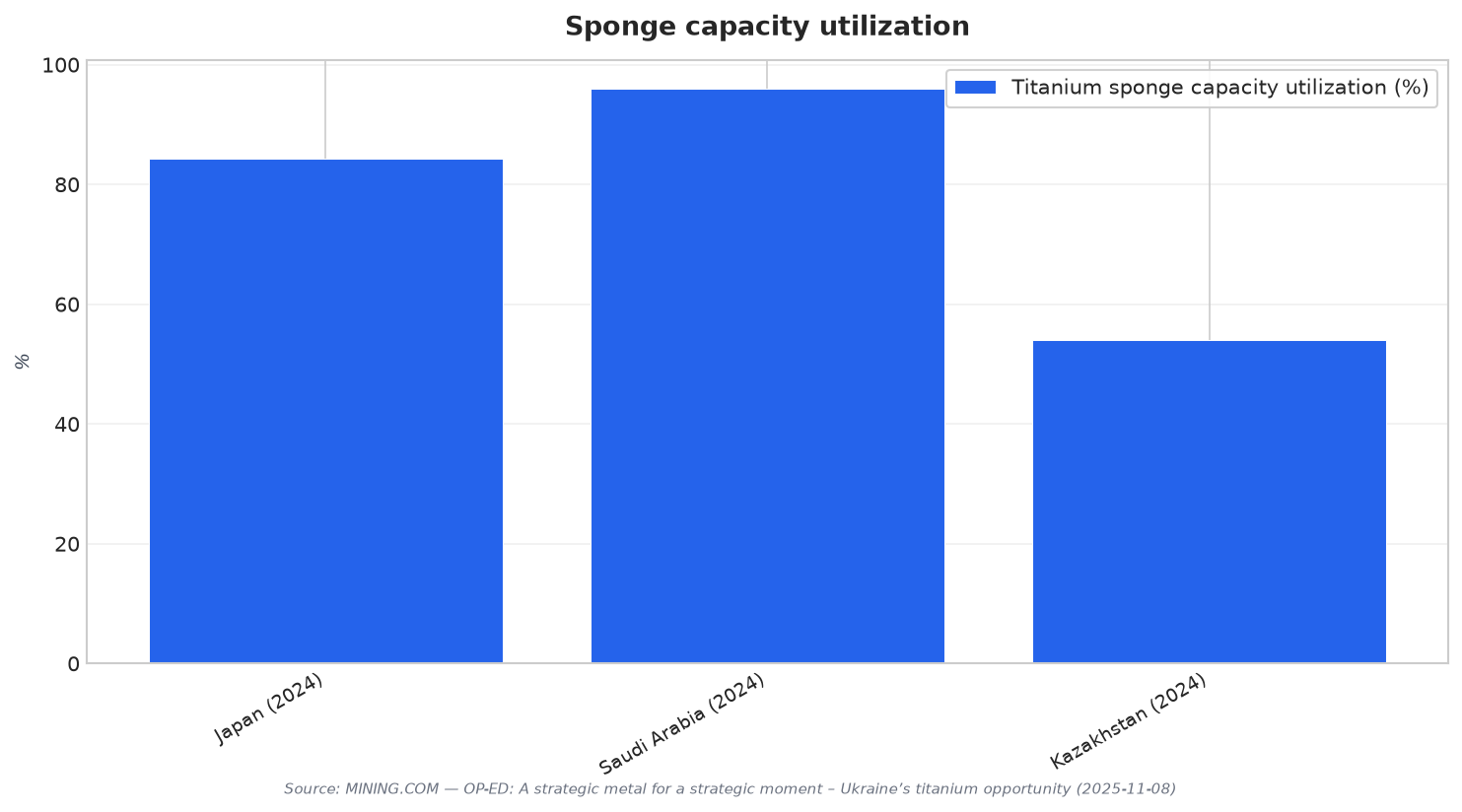
Midstream capability is a differentiator in any value-chain story, and Saudi Arabia appears to be operating close to its current limits. A MINING.COM op-ed reports that Saudi Arabia maintained near-full utilization at 96% of titanium sponge capacity in 2024, compared with Japan at 84.3% and Kazakhstan at roughly 54%. The same source says Japan, Saudi Arabia, and Kazakhstan are integrated into the US and EU titanium value chains as suppliers of high-quality midstream products. It also warns that expanding titanium sponge capacity is slow and capital-intensive, requiring “hundreds of millions of dollars in CAPEX” and close to a decade for Japanese and Saudi producers to meaningfully scale. That constraint makes downstream prioritization and feedstock security strategic.
From Ore and TiCl4 to Pigment and Metal: The Chain Saudi Arabia Can Tighten
The pigment-to-metal bridge runs through titanium tetrachloride (TiCl4) and chloride-route processing choices. IndexBox points to capacity additions in China, India, and Saudi Arabia, where new chloride-route TiO2 plants are replacing older sulfate processes. It also frames the Middle East & Africa as an emerging titanium chloride market, driven by new TiO2 pigment and polyolefin capacity in Saudi Arabia, the UAE, and South Africa, with low energy costs and access to chlorine from petrochemical complexes described as a competitive advantage. However, IndexBox also flags import dependence for titanium ore as a constraint, which places extra emphasis on logistics, blending strategies, and long-term contracts for rutile and ilmenite.
Mineral-sands trade flows help show how that constraint can be managed in practice. MarkWide Research says Western Australian dredge miners supply rutile and synthetic rutile concentrates to chloride-route pigment plants in Saudi Arabia and the UAE. It defines rutile as a naturally occurring titanium dioxide mineral exceeding 90% TiO2 purity and notes it commands premium positioning for aerospace sponge and chloride pigment feedstock. The same source adds that pigment producers in Saudi Arabia and the UAE are adopting high-temperature fluidized bed chlorination to process imported ilmenite concentrates on-site, and it highlights that chloride-route facilities in Saudi Arabia and the UAE are expanding. That combination creates a practical pathway: import and upgrade feedstock, make TiCl4 efficiently, and then direct outputs to pigment or to metal-linked intermediates depending on demand cycles.
Demand pull from aerospace provides a clear reason to pursue integration, but it also sets a quality and certification bar. Mordor Intelligence reports aerospace and defense held 51.63% of titanium market share in 2025 and notes that certification cycles in aerospace extend 15–25 years, which tends to lock in procurement once an alloy is approved. It also states that the Airbus A350 and Boeing 787 families each incorporate more than 70 metric tons of titanium, illustrating why stable, certified supply is valuable. IndexBox adds that TiCl4 offtake is expected to grow 4–5% annually through 2035, tied to aerospace build rates and defense spending. In this context, the titanium value chain Saudi Arabia is building is best understood as a coordinated set of choices across feedstock, chlorination, pigment capacity, and midstream metal inputs that can meet long-cycle aerospace demand.
What signals support a pigment-to-aerospace titanium chain in Saudi Arabia?
How utilized is Saudi Arabia’s titanium sponge capacity?
Why is TiCl4 important for both pigment and titanium metal pathways?
What feedstock link connects Australian mineral sands to Saudi chloride-route plants?
What makes scaling titanium sponge capacity difficult for the Saudi value-chain ambition?