Saudi Arabia has launched a new national skills framework for the mining and industrial sectors, aiming to standardize job roles and support workforce development. The initiative was unveiled by Minister of Industry and Mineral Resources Bandar Alkhorayef on the sidelines of the Global Labor Market Conference 2026, according to Arab News. Alkhorayef described it as a tool that ensures clear definitions of occupations and their required skills. He said it will cover more than 500 job roles and detail the necessary skills, responsibilities, and titles. The goal is to help employers, job seekers, and training providers navigate labor demand as investment accelerates in manufacturing, minerals processing, and related value chains under Vision 2030.
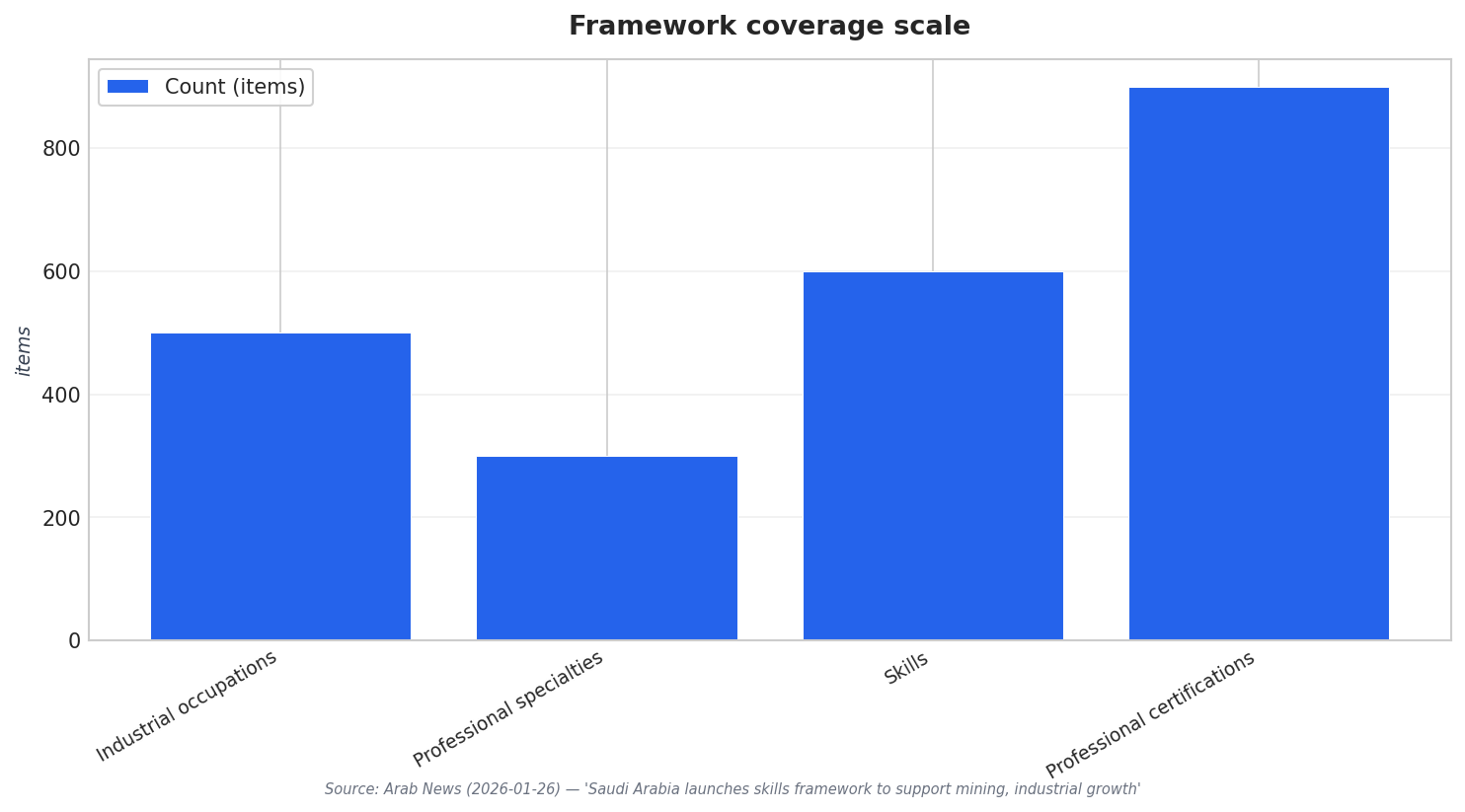
The Ministry of Industry and Mineral Resources said the initiative, known as the Industry & Mining Occupations & Skills Framework, will serve as a national reference for occupations and skills in mining and industry. In official descriptions, it is designed to strengthen workforce planning, training programs, and career pathways, while supporting informed decision-making. Arab News reported that the framework spans more than 500 industrial occupations, over 300 professional specialties, 600 skills, and 900 professional certifications. By setting standardized job titles, descriptions, and skill requirements, it is positioned to support recruitment, performance management, and competitiveness across the industrial and mining ecosystem.
Why Standardized Skills Matter for Mining Growth
The rollout comes as Saudi Arabia pushes mining as part of its economic transformation under Vision 2030. Arab News reported that the Kingdom’s mineral wealth is valued at $2.5 trillion and framed mining as a third pillar of the national economy alongside hydrocarbons. Export figures in the same reporting underline momentum in parts of the value chain. Saudi Arabia exported 5.7 million tonnes of phosphate fertilizer in 2024, up about 6 percent from 2023, according to a GASTAT report cited by Arab News. Against that backdrop, a common, national language for roles and skills can help align hiring, training, and advancement to the needs of expanding extraction, processing, and logistics activities.
Saudi Arabia’s broader approach to skills standardization also appears in labor market initiatives beyond mining. The Ministry of Human Resources and Social Development describes its work to define and identify skills at the labor market level, standardize skill concepts, and determine the skills associated with each occupation, creating a unified language connecting the labor market and the education system. Separately, the Saudi Standard Classification of Occupations is described as an official national system to unify, define, and code job titles and professional designations in a standardized manner. It also warns that selecting an inaccurate title can cause problems in skill assessment, Social Insurance subscriptions, and nationalization programs. Together, these efforts create the setting in which the Saudi Arabia mining skills framework can be applied consistently across employers and institutions.
Skills and role clarity also intersect with operational constraints that industry observers track. A mining equipment market report from Mordor Intelligence noted that a skill-based work permit scheme launched in July 2025 categorizes operators across three tiers, while supply lags behind demand for roles such as autonomous haul-truck supervisors and high-pressure grinding-roll technicians. The same report described how utilization can dip when machines queue for licensed drivers, affecting productivity assumptions. Within that context, a national framework that maps occupations to skills, responsibilities, and certifications can support clearer training pathways and hiring signals. It can also help training providers and employers coordinate on what “job-ready” means across sites and contractors.
What is Saudi Arabia’s mining skills framework designed to do?
How many roles and credentials does the framework cover?
Where was the framework announced?
What export figure was cited as mining-related momentum in Saudi Arabia?