Egypt and Saudi Arabia are positioning their mining relationship as more than a diplomatic talking point. In late September 2026, Egypt’s Minister of Petroleum and Mineral Resources Karim Badawi met Saudi Deputy Minister of Industry and Mineral Resources for Mining Affairs Khalid bin Saleh Al-Mudaifer to discuss cooperation in training and the exchange of mining expertise. The meeting took place on the sidelines of the Egypt Mining Forum 2026 in the New Capital. Badawi framed the opportunity around shared geological characteristics within the Arabian-Nubian Shield, arguing that common ground in geology can translate into expertise transfer, stronger investment flows, and more effective mineral resource development across both countries.
The scale of the geological setting helps explain why this partnership language is gaining traction. One source describes the Arabian-Nubian Shield as almost 3 million square kilometers and stretching across nine countries, from the eastern Nile basin to the Saudi highlands, including maritime areas leading to the Suez Canal. Another source narrows in on the Arabian Shield inside western Saudi Arabia at approximately 630,000 square kilometres, and cites preliminary geological assessments suggesting more than $2.5 trillion worth of mineral reserves distributed across hundreds of thousands of square kilometres. While those figures are not specific to Egypt, they provide regional context for why cross-border learning and coordinated exploration are repeatedly presented as practical next steps.
From Policy Signals to Project Readiness
For Egypt, the cooperation message lands at a moment of stated domestic ambition. An investor-focused overview of the Egypt Mining Forum says Egypt’s mining sector currently generates approximately 1% of GDP, and that the government has publicly committed to expanding that contribution to 6%. The same source uses other countries only as comparison points: it notes mining at roughly 6% of GDP in Ghana, 5% in Tanzania, and phosphate-driven mining at approximately 3% in Morocco. In this context, Egypt-Saudi collaboration on capabilities—especially training and operating know-how—can be read as a way to compress the learning curve and support the kind of sustained exploration and development implied by that GDP target.
Institutional reforms and data quality are also being presented as investment enablers. In the September 2026 meeting, Badawi highlighted efforts to develop the sector’s institutional framework and transform the Egyptian Mineral Resources Authority into an economic authority, with the goal of improving its ability to manage and exploit mineral resources and maximize returns. He also pointed to efforts to expand mining industries and maximize added value from mineral resources and ores. Al-Mudaifer praised Egypt’s move toward conducting airborne mineral surveys, calling them an important tool for delivering more accurate and comprehensive data on geological and mining potential, supporting exploration, and improving the sector’s attractiveness to mining investment.
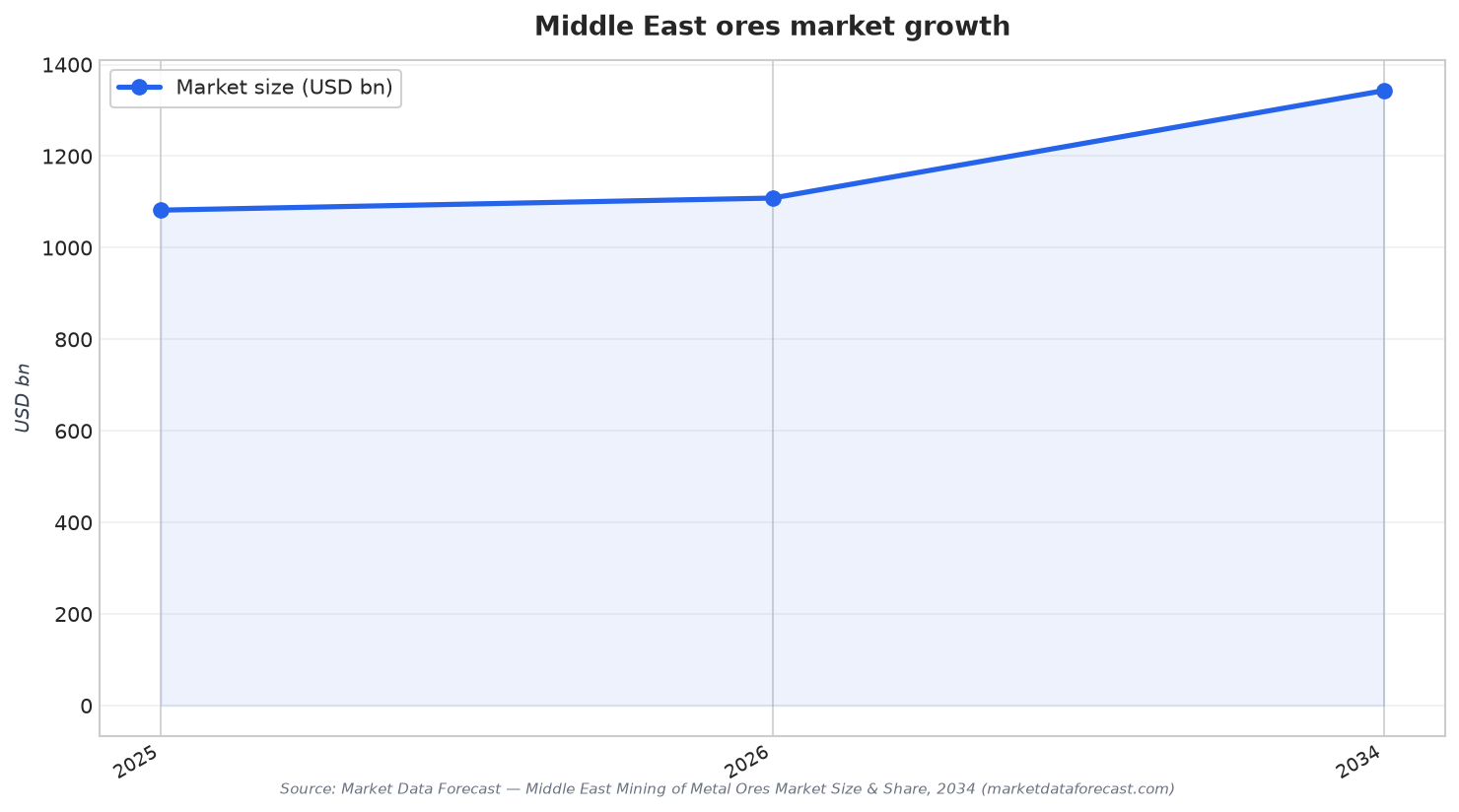
The broader market backdrop adds urgency, even if it does not describe either country on its own. A Middle East market report values the Middle East mining of metal ores market at USD 1,082.12 billion in 2025, estimates USD 1,108.42 billion in 2026, and projects USD 1,343.14 billion by 2034, with a CAGR of 2.43% from 2026 to 2034. The same report notes that copper ore accounted for 34.2% of market share in 2024 (for the Middle East market scope), and that concentration accounted for 52.3% of market share in 2025. Against that regional context, Egypt Saudi Arabia mining cooperation is increasingly described in practical terms: align skills, improve geological intelligence, and build credible pathways from shared Shield geology to bankable exploration and downstream value.
What did Egypt and Saudi Arabia discuss at the Egypt Mining Forum 2026?
Why is the Arabian-Nubian Shield central to Egypt and Saudi mining ties?
What is Egypt’s stated mining-sector GDP ambition?
How do airborne mineral surveys fit into the cooperation agenda?
How can Egypt–Saudi mining cooperation support investment readiness?