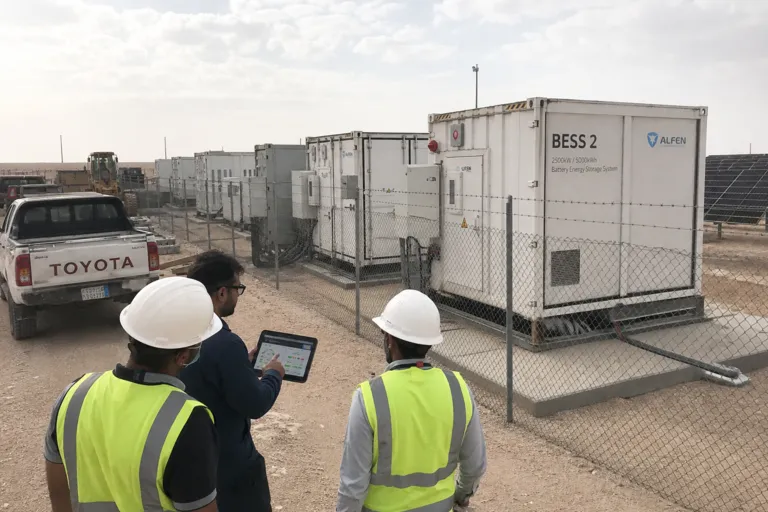
Saudi Arabia’s microgrid momentum is being shaped by energy diversification goals, renewable integration targets, and the need for resilient decentralized power across urban, industrial, and remote regions. Multiple sources describe a clear shift toward combining solar PV and wind with energy storage so sites can support grid reliability or operate off-grid with stronger uptime. In this context, the mine site battery storage microgrid Saudi Arabia discussion is less about a single technology and more about a system architecture: on-site generation, battery storage, and advanced control software designed to keep operations stable during disturbances and in harsh environments. The same drivers that push industrial clusters and special zones toward autonomous power are also relevant to mining sites that need reliable, cost-aware electricity without over-reliance on diesel.
Market forecasts underline how quickly this is scaling inside the country. Mobility Foresights projects the Saudi Arabia Microgrid Market to grow from USD 290 million in 2025 to USD 1,520 million by 2032, at a CAGR of 28.0% over the 2025–2032 period. In parallel, it forecasts the Saudi Arabia Industrial Microgrids Market rising from USD 14.8 billion in 2025 to USD 33.6 billion by 2032, at a CAGR of 12.4% during 2026–2032. Those industrial deployments explicitly include mining sites alongside manufacturing plants, refineries, ports, and large campuses. The same sources also stress that performance gains come from battery storage, power electronics, and intelligent controllers that balance loads and resources in real time and support peak shaving, load shifting, and backup power in both grid-connected and islanded modes.
Why Battery Modules and Controls Are the “Next Phase” for Remote Mines
Across the Middle East, energy storage module demand is accelerating, with IndexBox citing utility-scale projects as an estimated 70–80% share of annual deployment volumes through 2035. It also places 2026 system pricing for utility-grade Energy Storage Modules in the $140–190/kWh range for turnkey DC blocks, while noting that the region remains structurally reliant on imports for LFP cells and power conversion equipment. For remote industrial off-grid applications—specifically including mining and upstream oil and gas—IndexBox describes EsM-plus-solar configurations as a high-growth sub-segment that displaces legacy diesel generation. It also observes a shift in duration specifications from standard 2–4 hour configurations toward 6–8 hour systems, expanding the use case from fast grid services into multi-hour renewable firming that can better match mining load profiles.
Operational execution matters as much as hardware. IndexBox highlights 6–12 month lead times for high-specification components such as liquid-cooled enclosures and high-voltage power conversion systems. It also points to skilled workforce constraints in integration, commissioning, and operations and maintenance, estimating lifecycle costs can be 15–25% higher than mature storage markets in Europe or North America. For Saudi deployments, other sources emphasize that advanced control systems, AI-enabled energy management platforms, and predictive energy management are enhancing microgrid visibility and performance. Mobility Foresights also connects microgrid growth to policy emphasis on resilience, cybersecurity, and localized power generation, and notes programs tied to rural electrification and electrified water treatment or mining sites as contributors to uptake in remote environments.
Regional comparisons show how mining can pull off-grid storage forward, while Saudi Arabia’s own pipeline is framed by broader directives that treat storage as essential infrastructure. Mordor Intelligence reports that, across the Middle East and Africa BESS market, off-grid systems are forecast to expand at a 26.1% CAGR, driven by African mining firms replacing diesel with solar-plus-storage hybrids that achieve a levelized cost of less than USD 0.10/kWh. As a concrete example in Africa, it states Zambia’s Kansanshi copper project will pair 100 MW of solar with 40 MWh of storage to target full energy autonomy by 2026. For Saudi Arabia, the same Mordor excerpt also references mandates and frameworks expressed in GWh (including a 26 GWh mandate by 2027 in Saudi Arabia). Taken together, the story for Saudi mining is moving beyond solar-only installations toward hybrid microgrids where batteries and controls shape resilience, runtime, and operational continuity.
What is driving microgrid growth in Saudi Arabia for industrial and remote sites?
How fast is the Saudi Arabia microgrid market projected to grow?
What is the forecast for Saudi Arabia’s industrial microgrids market?
How does a mine site battery storage microgrid in Saudi Arabia typically work?
What storage trends matter most for remote industrial and mining microgrids in the Middle East?